Your Software Interface is About to Become Disposable (And That's a Good Thing)
I can create a perfect comparison chart of GDP growth between any two countries from 1960 to 2025 in under ten seconds using modern tools. You're not beating that with a traditional BI tool, no matter how polished your interface is.

For forty years, we've treated user interfaces like precious artifacts. We designed them carefully, built them painstakingly, tested them exhaustively, and then forced millions of users to conform to their rigid structures. Remember Oracle? SAP? Even modern SaaS tools like Salesforce require certification courses just to use them properly.
This made sense when pixels were expensive. Every interface had to serve thousands of users across countless use cases. We couldn't afford to customize, so we standardized. We couldn't afford to iterate, so we ossified.
That world just ended.
The Tipping Point We Just Crossed
Three converging forces have fundamentally altered the economics of user interfaces:
1. Generative UI Technology
Tools like UI Wizard, v0, and Galileo can now generate complete, multi-screen interfaces from simple text prompts. What once took weeks of design and development work now happens in seconds. The technology for creating interfaces has become essentially free.
2. Ephemeral Interface Paradigms
We're developing new design languages for interfaces that appear, serve their purpose, and disappear. Think about how you use Perplexity or ChatGPT artifacts—you're already consuming disposable interfaces daily. These aren't bugs; they're features.
3. Agentic Software Integration
AI agents can now orchestrate multiple systems, decide what needs a visual interface, and generate those interfaces on demand. Google's image generation API is already being used to automatically create custom charts and graphs for internal metrics. The agent queries data, requests a visualization, and displays it—all without a designer touching anything.
What This Actually Means: The Three-Layer Stack
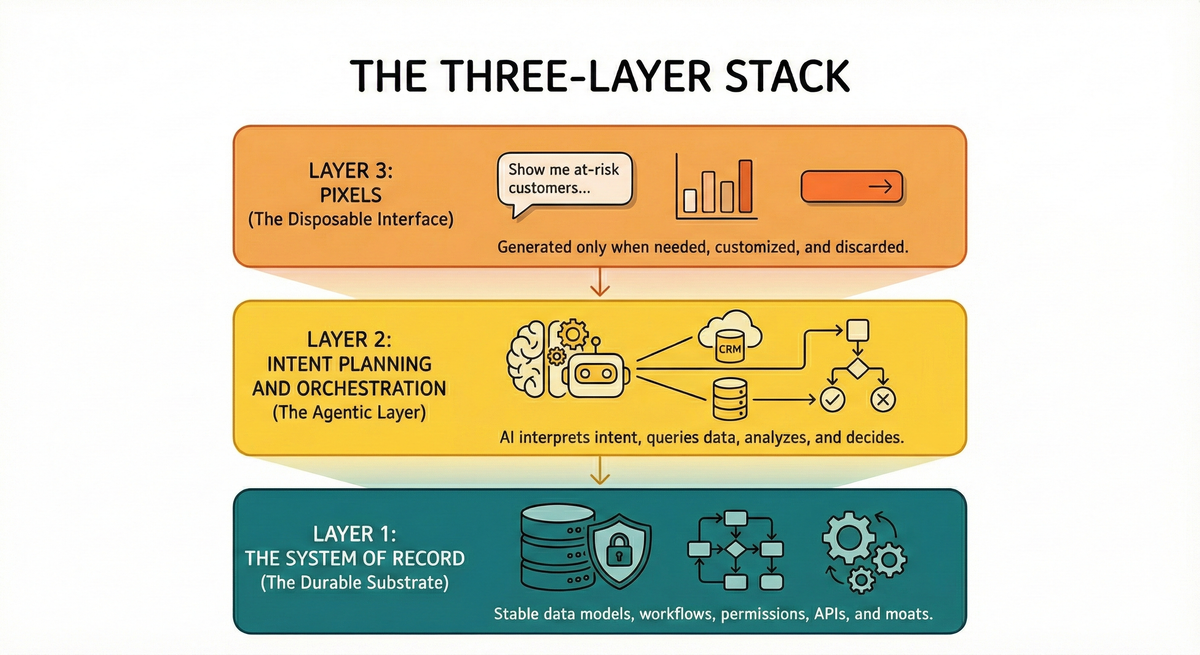
Software isn't dying. It's stratifying into three distinct layers:
Layer 1: The System of Record (The Durable Substrate)
This is where traditional B2B SaaS excels and will continue to thrive. Data models, workflows, permissions, audit trails, compliance frameworks, domain logic, forecasting engines, APIs—none of this goes away. This is where moats live. This is why companies like Salesforce aren't going anywhere.
The substrate must be stable, reliable, and trustworthy. This layer isn't changing; it's just moving down the stack.
Layer 2: Intent Planning and Orchestration (The Agentic Layer)
This is the new battleground. When you say "show me which enterprise customers in EMEA have renewal risk this quarter with a CSM touch gap longer than 45 days, then draft outreach emails," you're not clicking through seventeen screens anymore.
An AI agent interprets your intent, queries the CRM, analyzes the customer data warehouse, evaluates risk scores, and decides what needs your human judgment versus what can be auto-executed.
This layer is rapidly becoming agentic. Every serious B2B SaaS company is building some version of this right now.
Layer 3: Pixels (The Disposable Interface)
Here's where everything changes. Interfaces are becoming compiled artifacts of intent—generated only when human judgment is required, customized for the specific user and moment, and discarded when that moment passes.
Instead of handcrafted screens that must serve millions, you get a transient visualization rendered at runtime for this question only: a ranked table of at-risk customers, an inline suggested outreach, a cohort chart for exactly this query.
The New Economics of Software
Let me be clear about what's different:
Traditional Software:
- Time horizon: Months to build
- Design target: Personas and generalized workflows
- Mental model: "Learn this app"
- Cost structure: Heavy upfront investment
- Differentiation: Look and feel, UX patterns, workflow efficiency
Disposable Pixels:
- Time horizon: Seconds to generate
- Design target: One user, one moment, one goal
- Mental model: "State your intent, UI appears when needed"
- Cost structure: Heavy model training, functionally free iteration
- Differentiation: Outcomes, speed from intent to action
I can create a perfect comparison chart of GDP growth between any two countries from 1960 to 2025 in under ten seconds using modern tools. You're not beating that with a traditional BI tool, no matter how polished your interface is.
What This Means for B2B SaaS
If you're building, buying, or leading in B2B SaaS, this changes everything:
The primary surface is shifting. Right now, enterprise value is framed around "we own the primary surface where the job happens." CRMs think this way. ERPs think this way. But if the primary interaction moves to an agent or copilot surface, your UI becomes just a reference implementation—not the default touchpoint.
Your API matters more than your navigation bar. Bundling power shifts from "best dashboard" to "easiest for agents to choreograph." If customers use generative UI tools on top of your APIs, their internal design systems render their own views of your data. Your canonical UI is just one of many frontends.
You're at risk of disintermediation. Multiple SaaS products could get aggregated behind one agentic interface. Your relationship with the user becomes mediated.
Where SaaS still wins: You own the canonical state for something that matters—contracts, ledgers, records, risk models. You're embedded in domain flows that track real value. You're safe and predictable for agents to call. Strong schemas, good safeguards, and idempotent operations make you the reliable substrate others build on.
You become less of a "thing with screens" and more of a "high-integrity service that agents can rely on."
What Changes for Talent
Designers: You're shifting from owning specific flows and screens to defining interface grammars, constraints, and safe snap points for generative UI. You're becoming language designers and safety engineers for human attention.
Product Managers: The question changes from "what feature or page do we build next?" to "what intents do we support? What state changes must be safe? What decisions need human judgment versus full automation?" You're speccing intent-state-outcome loops, not static wireframes.
Engineers: Especially frontend engineers—you're moving from pixel pushing to building stable interfaces for agents, canonical shells, snap points, validation logic, and composable components within safe constraints.
Your backlog changes too. Instead of "add another settings page," you're working on new intents to support, new system behaviors, new constraints, new components the generator might use.
Where Coherent Interfaces Still Win
Not everything becomes disposable. Three domains resist this shift:
1. Cognitive Mapping for Complex Work
Humans rely on stable landmarks for complex domains like trading, medicine, and incident response. Deep spatial memory of tools matters. The Bloomberg Terminal looks like chaos to outsiders, but professionals depend on knowing exactly where everything is. Completely shifting pixels every time adds cognitive load and risk.
2. Audit, Training, and Compliance
Regulated environments need reproducible flows. "Show me exactly what the user saw when they approved the loan" doesn't work with ephemeral UIs unless you can capture and version the UI spec itself as a first-class artifact—which gets complicated fast.
3. Team Collaboration
Shared work needs shared views. "Look at this dashboard" and "check this queue" break down if everyone has different ephemeral panels. You need explicit mechanisms for pinning, sharing, and standardizing.
This is why Slack is quietly winning in a generative UI world. Not because Slack itself is generative, but because it's stable, familiar, and increasingly where generated outputs get shared. When people create charts with AI tools, they post them to Slack. Slack becomes the stable substrate for team collaboration in an otherwise fluid interface landscape.
The Mature Pattern: Both/And, Not Either/Or
We don't need a binary fight. The future isn't "B2B SaaS is dead" versus "we'll never see generative UI in serious applications." Both takes are wrong.
The mature pattern is a spectrum:
- Highly standardized, coherent shells for regulated flows, shared operational views, team training, and collaboration
- Disposable pixels operating inside that shell for exploratory analysis, micro-decisions, personalized shortcuts, and "just for me" flows
Anyone who's managed a serious SaaS application knows we maintain hundreds or thousands of pages, many of which we'd love to make generative because they're expensive to maintain and rarely visited. Traffic in SaaS applications decays exponentially—your top three pages account for most traffic, but you put equal work into pages only a handful of people use. Those are the pages at risk.
We're moving toward SaaS applications with two or three main durable pages and everything else generated on the fly, possibly saved by users if they want that view again, but fundamentally more composable and contextual.
Who Wins and Who Loses
Winners:
- Products that are agent-addressable with clean schemas
- Products that can be composed and orchestrated
- Teams that treat UI as a language and runtime, not frozen screens
- Individuals who understand the substrate matters more than the pixels
Losers:
- Products whose only moat is "our interface is beautiful"
- Vendors who resist being called by higher-level agents
- Companies that insist users live inside their monolith
Even the monolith strategy has a shelf life. By 2026, users could have morning voice conversations with agents that use computer-control tools to browse your closed system, extract data, and bring it back—all while you insist only humans can use your interface.
The Bottom Line
Software is decoupling into substrate and pixels. The substrate needs to be stable, durable, and trustworthy. The pixels matter a whole lot less.
This isn't just BI teams saying "give me the data, not your fancy dashboard" anymore. It's marketers. It's operations. It's everyone.
The user is going to choose their interface. This will be true for consumers and businesses alike.
And it's going to change everything.
What are you seeing in your organization? Are you building for the substrate or still optimizing pixels? Reply and let me know—I read every response.